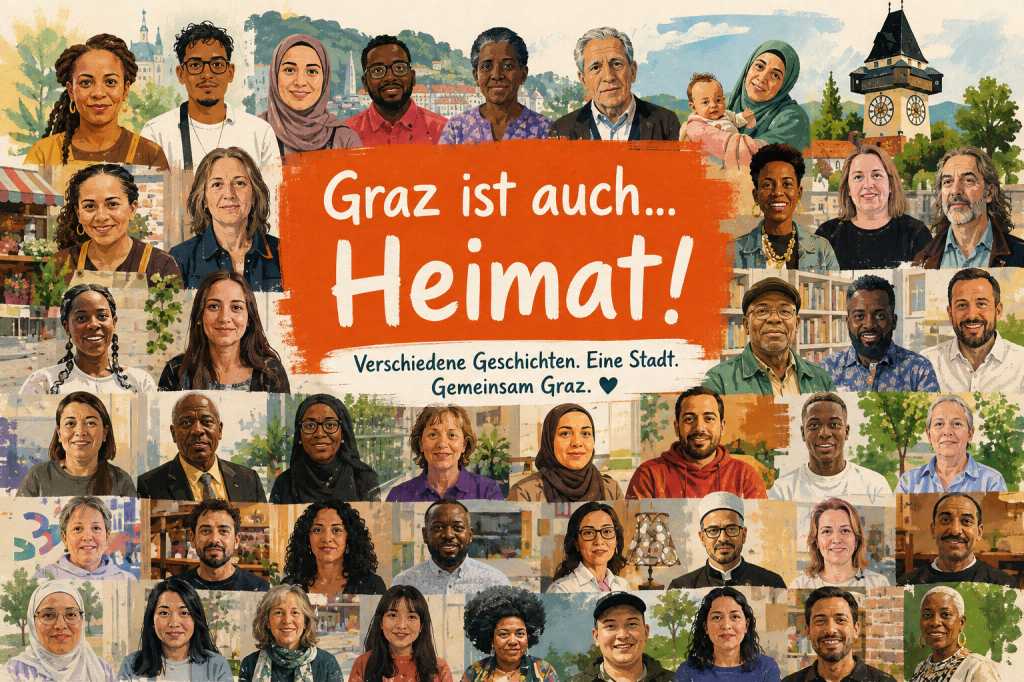
What helps you truly feel at home in a new country? We met Sara Crockett to talk about international life in Graz, community, the International Women’s Association and the Migrant:innenbeirat.
Did you know that Graz has political representation specifically for non-EU citizens? Or that there is an international women’s community bringing together women from more than 25 countries?
I recently met Sara Crockett, and through our conversation I discovered more about some very interesting initiatives that exist for international residents and migrant communities in Graz.
And I thought: if I didn’t know about all of this, maybe some of you don’t either.
Our conversation started with international life in Graz, but quickly became something much bigger. We talked about moving countries, learning German, finding your people, building community, the International Women’s Association Graz and the Migrant:innenbeirat.
So instead of simply explaining these organizations, we wanted you to meet Sara too.
Meet Sara Crockett
Sara is originally from the United States and has lived in Graz for more than 20 years. She came to Graz after her husband, whom she met in the United States, got his first job at the university here. At first, they thought they might eventually return to the United States or move to Germany. But life continued. Jobs came, opportunities appeared, and Graz slowly became home. One part of her story that I found especially relatable was learning German.
Sara told me that it took her around five years before she really felt comfortable having conversations in the language. She also mentioned an interesting challenge that many internationals in Graz might recognize: because so many people speak English, conversations often switch to English very quickly, which can make practicing German harder.
Today, Sara is active in Graz’s international community and has experience with both the International Women’s Association of Graz, known as the IWA, and the Migrant:innenbeirat. I sat down with her to understand more about her story and some of the initiatives internationals in Graz should know about.
The Interview
Geovana: How did you end up living in Graz?
Sara: My husband is from Germany, and I met him in the United States when he was studying there. He got his first job here at the university and came to Graz around 22 years ago. We always thought we would eventually go back to the United States or Germany, but we never did. He had his job, then I got a job, then he got another job, I got another job, and we just stayed. And Graz is really nice. I’ve been here ever since.
Geovana: Was learning German difficult for you?
Sara: It took me a long time. I think it took almost five years before I really felt that I could comfortably have conversations in German. It’s not an easy language. And I think Graz can sometimes make it a little more difficult because so many people speak English or another language. Sometimes people immediately switch languages when they hear you’re struggling. But then you can’t practice. You really have to practice. Sometimes you have to be forced to speak German, otherwise it doesn’t happen.
The Initiative Sara Once Described as a “Lifesaver”
One of the strongest parts of our conversation was about community. Sara told me that when she first came to Graz, the International Women’s Association Graz played an important role in helping her build a life here. She described it as a “lifesaver.”
Geovana: What helped you most when you were new in Graz?
Sara: For me, when I came to Graz, the International Women’s Association was like a lifesaver. Of course, you’re learning German, you’re working and you’re trying to establish your life here. But within the group, you meet women who have already been here longer and know many of the issues, difficulties and challenges you encounter when you move here. They have experience dealing with those things. Or you meet women who are also relatively new and are going through the same challenges at the same time. Then you can talk to each other, complain sometimes, exchange experiences and get feedback about what to do.
Geovana: What exactly is the International Women’s Association of Graz?
Sara: The organization has been in Graz for more than 30 years. It started in 1994. Today we have around 110 members, and I think our members currently come from about 25 or 26 different countries. There’s also a huge age range. The youngest women might be around 25, while some members are almost 85. The main goal is really social networking. When somebody first arrives, we try to connect her with other women in the organization. Then you have somebody you can call. You have somebody you can meet for coffee. We have coffee mornings and book clubs. We go to the opera and theater, we go hiking and explore different activities. The idea is simply to create opportunities for women to spend time together and talk.
Sara also explained that the IWA offers different ways for women to stay connected, even if they do not attend every activity. The organization uses a WhatsApp community with several interest groups, a Signal group and a newsletter.
I found that detail interesting because community doesn’t need to look the same for everyone. Some people want to attend events every week. Others just want access to information or a group they can contact when they need something.
A Surprising Connection Between Graz and Brazil
Then Sara told me a detail I definitely wasn’t expecting. The history of IWA Graz has a connection to Brazil.
Geovana: And I heard there is actually a Brazilian connection in the history of the IWA?
Sara: Yes. The organization started because an American woman who had been living in São Paulo, Brazil, moved to Graz in the early 1990s. She had been part of an international women’s organization while living in São Paulo. When her husband got a job in Graz and they moved here, she started looking for a similar international women’s association. There wasn’t one. So she helped create one here. Within about two years, they already had almost 100 women. Many were connected to international companies, but there were also teachers, missionaries and Austrian women who had lived abroad and wanted to speak English or connect with the international community.
As a Brazilian, I obviously loved discovering that little connection.
Why Finding a Community Can Change Everything
This part of Sara’s story immediately resonated with me. When I arrived in Graz, meeting part of the Brazilian community also gave me a feeling of identification. There is something comforting about meeting people who understand certain references without needing an explanation.
The food; The music; The humor; The traditions.
Or simply what it feels like to miss home while trying to build a new one somewhere else. And maybe that is one of the most important lessons from initiatives such as the IWA. They don’t solve every challenge of moving abroad. But they make sure you don’t have to experience all of those challenges alone.
And Then I Learned More About the Migrant:innenbeirat
Another initiative I wanted to understand better after meeting Sara was the Migrant:innenbeirat Graz (Migrants’ Advisory Council of Graz). This organization has a very different role from the IWA. While the International Women’s Association focuses mainly on social connection and community, the Migrant:innenbeirat is a group that represents the political interests of migrants in Graz.
It has nine members from non-EU countries who work voluntarily and meet regularly. Its meetings are public, and the work of the elected representatives is supported by the council’s office.
The Migrant:innenbeirat has existed since 1995. Its former name was Ausländerbeirat.
What I found particularly interesting is the way its members are chosen.
Non-EU citizens living in Graz who are eligible to participate vote for their representatives through a direct and secret election. The election takes place at the same time as the Graz municipal election, and representatives serve for five years. That means this isn’t simply an organization talking about migrant communities. It creates a formal space where non-EU citizens themselves can choose who represents their interests.
Geovana: Why is something like the Migrant:innenbeirat important?
Sara: It gives migrants a way to have their interests represented politically in Graz. There are people living here who come from non-EU countries and don’t have the same possibilities to participate in municipal politics. The Migrant:innenbeirat gives those communities another form of representation. It’s also important that people know it exists and understand how they can participate.
Integration Isn’t Only About Learning German
After meeting Sara, I kept thinking about how we normally talk about integration. Most of the conversation focuses on what migrants should do: learn German, find a job, understand Austrian culture and adapt to a new environment. And yes, all of those things matter. But there is another side that deserves just as much attention:
What opportunities exist for people to connect and participate once they arrive?
Are there communities where newcomers can find support?
Can international residents meet people who understand similar experiences?
Do non-EU citizens living in Graz know where to find information or how to make their perspectives heard?
This is why I found Sara’s story and the initiatives she introduced me to so interesting.
The International Women’s Association Graz helps women build social networks, friendships and a sense of community.
The Migrant:innenbeirat offers political representation for non-EU citizens living in Graz.
They have very different roles, but both show that integration is not something people have to navigate completely alone.
Sometimes feeling at home starts with something as simple as meeting the right people, discovering that a community already exists and realizing that there are ways to participate in the city around you.
Maybe You Don’t Need to Figure Everything Out Alone
One thing Sara said stayed with me.
When she arrived in Graz, women who had already lived here longer could help newer members because they understood many of the same problems and challenges. More than twenty years later, Sara is now one of the people sharing knowledge with others.
I think there is something beautiful about that cycle. You arrive needing a network. And after some time, you can become part of someone else’s network. That is one of the things community can do.
Did You Know These Initiatives Existed?
I didn’t fully understand all of them before this conversation. And that is exactly why I wanted to share this story. The longer I live in Graz, the more I realize that discovering the city isn’t only about finding another café, event, lake or hidden place. There is another side of Graz to discover.
The associations.
The international communities.
The people creating projects.
The public initiatives.
The possibilities to participate.
And maybe we should talk about those things more often too. Because moving somewhere and really feeling part of that place are two very different things.
Finding your community, understanding your possibilities and realizing that you can also contribute to the place you now call home can make all the difference.
And sometimes the first step is simply discovering that these initiatives exist. So, did you know about them?





Leave a comment